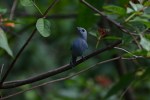
The third day of our adventure started yet again with a wonderful Pax breakfast, but this particular morning I explored the lower balcony and the appropriately named “Hummingbird Trail”. As you would expect, I came down to breakfast most mornings with both my notebook, my semi-permanently borrowed Trinidad and Tobago bird book, and my camera (OK, I almost always had those three things with me…). While the view from the upper terrace looked out onto both the city and some upper canopy up the mountain (there was a fantastic avocado tree with fruits just hanging over the railing so close to the tables that if they were ripe they’d basically be serving them selves to diners), the lower terrace looked into the chaotic world that is a tropical forest. Pax puts out both hummingbird feeders and flat fruit feeders to attract birds, and birds there were a plenty. In the brief time I had to sit and watch, I saw everything from tanagers, bananaquits, honeycreepers, buzzbirds (what I will call hummingbirds from now until forever), and lizards that could only be seen when they moved. Needless to say, I liked it there.


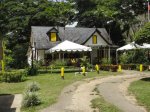
When Eric pulled the bus up the driveway, I was forced to pull myself away from the endless wonders of the forest and move on to the new endless wonders of Lopinot. As mentioned earlier, one of the previous waves of colonizers to come to Trinidad were the Spanish, but the French managed to have their say in the island’s history as well. The valley in which Lopinot sits was colonized by the Spanish, while the town itself was built in the early 1800’s around a French cacao plantation established by the Compte (Count) de Loppinot, a French knight who had influence all over the “New World”. A number of other groups influenced the diverse history of the village, including Indian newcomers freed from indentureship and a near by Spanish city whose inhabitants had the option of moving to Lopinot after their original city was flood in the 1940’s by the construction of a dam. To make a 200 year long story short, Lopinot had a lot going on both historically and currently.
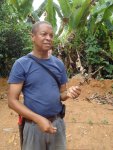
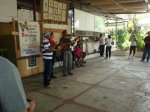
Our hosts during our time there were the wonderful folks at the Cafe Mariposa, specifically Arthur (pictured below), who would be our guide for the day. To begin the experience, Arthur and a number of other people gathered around the group and sang us a welcoming song in the musical style parang (more on that in a bit) entitled “Consider Yourself One of Us”. They continued to regale is with a few more songs, some in English and some in Spanish, all of which were fantastic, fun, and accompanied by maracas, which is always a good thing. After we had a bit of an overview of the area’s history, Arthur walked us around the village and out to his farm.

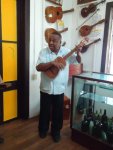
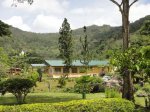
A lot of the original buildings have been preserved, including one currently housing a small museum. We were given a wonderful history of the village and also of parang, the Spanish / Caribbean fusion musical style deeply rooted in the history of Lopinot. Martin, the curator, gave us a demonstration of a number of the traditional instruments used in parang including a cuatro, a small four stringed instrument similar to a ukulele, maracas, and wood blocks. Hypothetically, we were taught some different rhythms, given the maracas and wood blocks, and told to clap along to his expert singing and playing. Even though our accompaniments were occasionally off, it was still great fun. For a good example of parang in Lopinot, see this YouTube video.

Martin also gave up a brief rundown of the plantation’s history of ghosts, including the Count himself, which can be seen in this convenient Ghost Hunters International episode, shot only months before we got there. I haven’t watched it all yet (I think it might kind of suck a lot, and probably sensationalizes basically everything possible), but I recognize a lot of the people interviewed, all of whom couldn’t talk about what the Ghost Hunters team had found while we were visiting as the episode hadn’t aired yet.
For the ease of reading, I’ve broken this post up into two. I do tend to be a bit long winded, my apologies, but the rest of the story is totally worth reading…








 what Was, what Is, and what Will Be