
Our first stop near after the museum was to see the two original cacao drying houses which had roofs that completely rolled back off the foundation to expose the rafters where the cacao was laid to dry. According to the Ghost Hunters episode intro, the bottom part of the drying houses were used as a jail for slaves, but we were mostly told about the cooler parts of the town’s history.

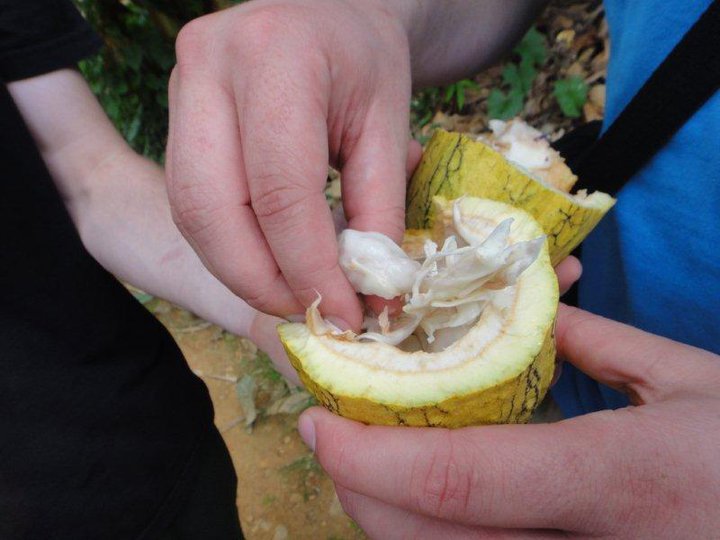
There were still cacao trees around the city, and the students finally got a taste of real chocolate. Cacao (simply called coco by the Brits, Theobroma cacao by the sciency types, and is where the beautiful chocolate comes from) is hard to describe. What we think of as “chocolate” is a far cry from its original form.
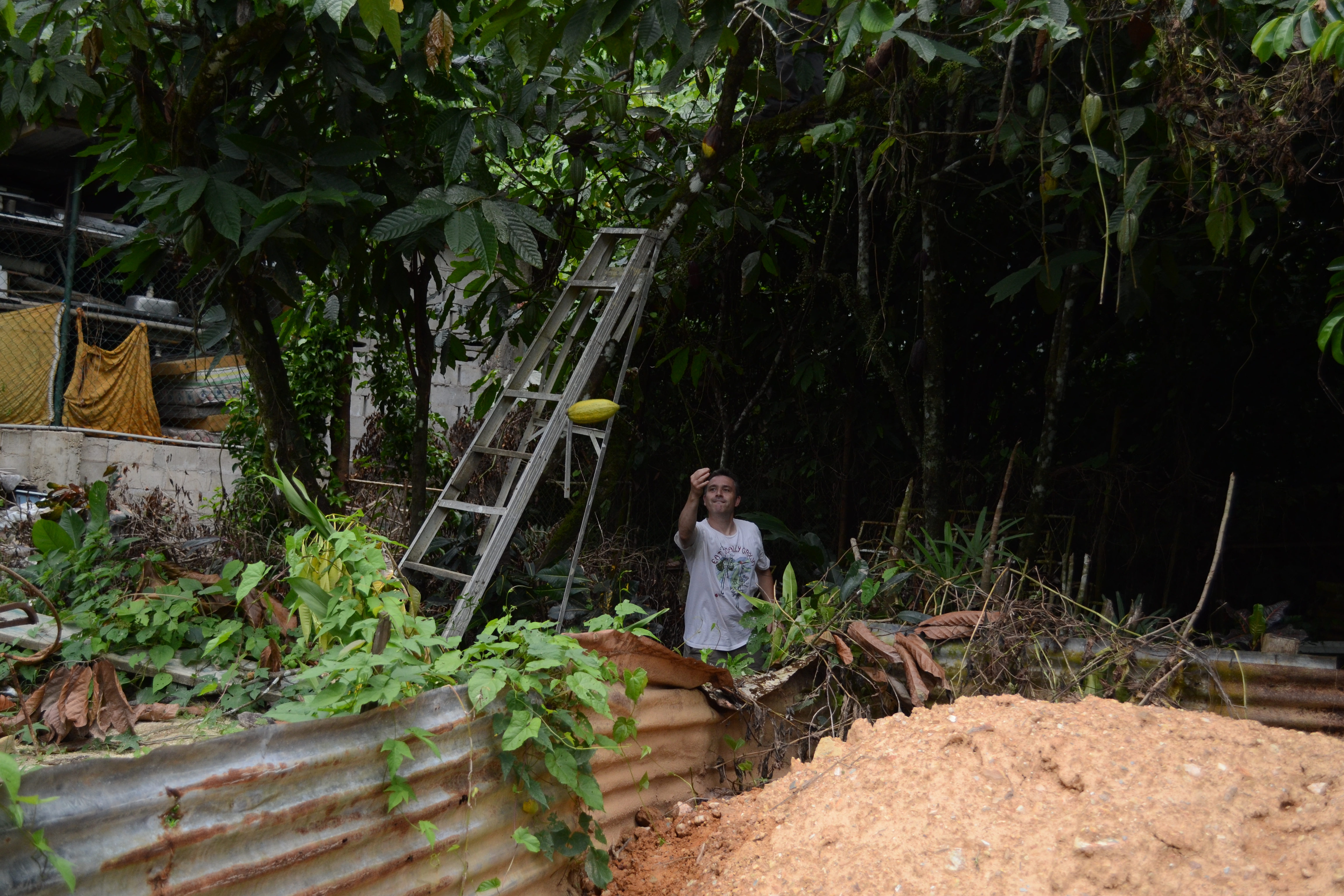
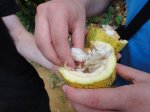
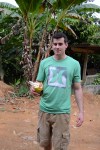
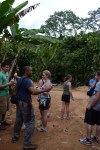
Cacao pods, which do indeed grow on trees (directly from the tree trunk to be specific, Hallett is tossing a pod that Arthur had just harvested from the tree to the group in the picture above), contain a core network of beans the size of polished river rocks surrounded by a delicious white pulp. I’m cheating ever so slightly with the cover picture, it’s actually cacao from Costa Rica, but it better illustrates the crazy “from the trunk” growth that is indicative of the species. Surprisingly, it’s the pulp that’s the best part of a ripe pod. Each variety of cacao has slightly different tasting pulp, but they all are really sweet and very very tasty. The seeds, as they are in the ripe pod, are fantastically biter and also fantastically purple.
To make chocolate, the seeds are separated from the pod and the pulp, dried (like in the cool houses in the village), then roasted. Ok, there are a lot more steps in making what we think of as chocolate than just that, all of which I’ve learned in a number of classes, but we didn’t see that here. Point is, raw cacao pulp is absolutely heavenly, and not something that can be reproduced by anything outside of my imagination. For a slightly less confusing description of cacao, see the pictures, and I guess Wikipedia. Sorry, the visual aids don’t contain any tastes.
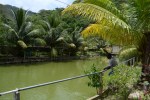
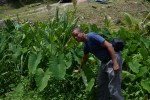
Arthur then proceeded to walk us around his farm, showing us one entrepreneurial endeavor after another. The farm had everything from a full vegetable garden, tons of crazy tropical flowers, fruit trees (including the wonderful cacao and coffee), a tilapia pond, and a new church that looked out onto the beautiful rectangle of a fish pond. Hallett said that most of these developments were new in the two years since he had been there last, showing the resolve that Arthur had for his projects.
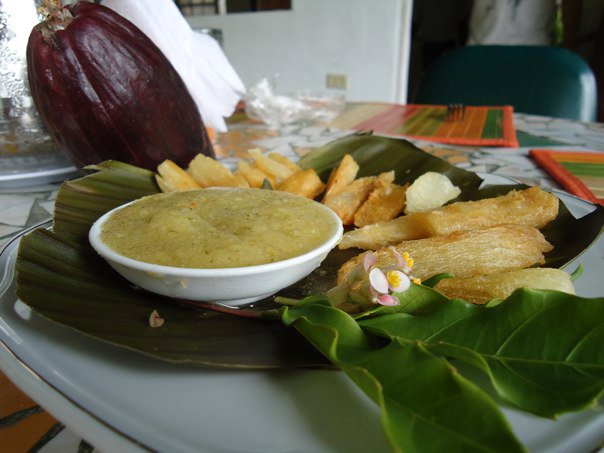
In an effort to save time and maintain readership, I will summarize lunch back at Mariposa via pictures and two words – fried yucca. Mmmmmmmm.
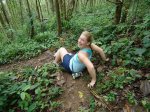
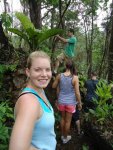
After the feast and a good tropical fast start / fast stop drencher of a rain storm, we were led on a nice little nature walk up the side of a mountain. Keep in mind it had just rained when you see some of us slipping… We went up back and forth via switchback foot trails surrounded by greens of as many shades as you can dream, tree seeds that look like dolphins once you carve the eyes, and lots of fauna that probably saw us far more than we saw them. Point in fact, our first brush with the illustrious Bothrops asper. For those not familiar with herpetological taxonomy, this would be the fantastically poisonous pit viper better known as a fer-de-lance. I tended to stick to the back of packs when we were walking like this, mostly so I could assuage my fears that I would loose a student at some point on the trip (and judging by the pictures I’ve scavenged from the students, I maybe wasn’t that far off, I’m really glad that only about two people got hurt on the whole trip), so I was the last in line to pass a bowl in the rocks next to the trail.

We had been told about the snakes in this area ever so briefly, and mentioned that they do tend to like curling in crevices just like that one, so when I walked past it, I looked in. Thankfully, I don’t have a picture (of this one…), because my choice was to pause and get out my camera, or keep walking and not risk getting lunged at. It’s diamond patterned body was coiled nicely back in the whole, but I’m dead sure that I saw it’s triangular head with black eye stripes raised above as if to say “yes? what do you want?”. Needless to say, I walked slightly more carefully (but also slightly faster) down the rest of the trail back to the cafe.
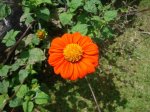
Ok, I’m fairly tired of writing at this point, and if you’ve made it this far, you’re probably tired of reading. We did a few more things that day, specifically our inaugural game of penultimate frisbee, but that will have to come in the next post. Thanks again to the students I’m stealing pictures from, (the labels on the picture files correspond to the initials of those who took the pictures, btws). The flower pics from Lopinot this time around were from Chris, our resident plant hugger, and a lot of the walking / misc pics came from Abby and Brittaney. I suppose I should introduce the students at some point… Think there are some nice group shots from the next day, perhaps I’ll do it then. But first, penultimate frisbee!







 what Was, what Is, and what Will Be
Leave a comment