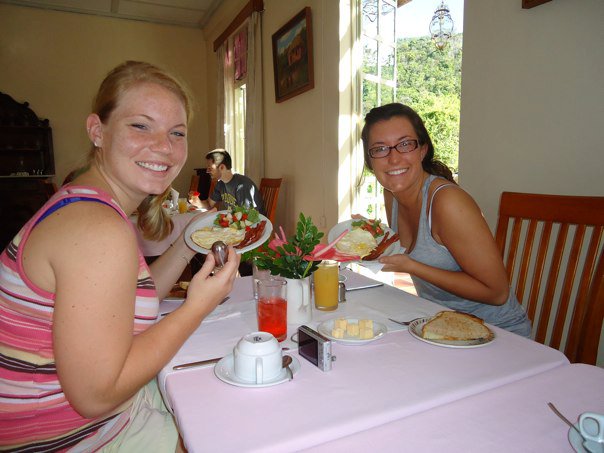
In the last few posts describing the first day, I intentionally omitted the discussion of food. I touched briefly on breakfast, and the surprise that awaited us in the dining room of Pax that morning, with subsequent variations on the same fruity theme greeting us each day we stayed at our home away from home (Chelsea and Brittaney seem happy with it, Chris seems like he’s still sleeping…). Breakfast was generally a constant that could be counted on to be relaxed and refreshing regardless of the excitement or shenanigans that occurred the day before. It involved familiar things, such as eggs and toast, mingled with some unfamiliar things, like salt fish and papaya. The bread at Pax, by the way, was hand crafted by the monks in the monastery just up the hill and was in itself superb, but when coupled with the variety of fruit spreads and jams that we had to choose from, became deliciously unique (many a piece was snagged from abandoned plates after students had gone back up to their rooms by the lingerers who stuck around for another cup of coffee and some bird watching before the start of the day).
This brings me to our first day time food adventure and our first encounter with the cultural combination that is all things Trini. To understand a lot of things in Trinidad, you have to remember that it has a history of colonialism by a number of European countries with trade in both commodities and people that reached halfway around the globe. In short, these Caribbean islands hosted a native population that was mostly driven out or killed by first Spanish then British settlers, with each successive wave of trade and plantation establishment bringing a different set of workers to the islands. The Spanish brought African slaves while the British brought Indian indentured servants. The legacy of both groups of workers now defines the population that is roughly half of African and of Indian descent. More recent history has involved emancipation and independence, further shaping the demographics of the cities versus the country side, but I’ll talk about that later.
What does any of this have to do with food, you ask?
Everything. The two main cultures that are represented in Trinidad are equally represented in the food, with tropical African dishes intermixed with Indian cuisine, making for a diverse and uniquely Caribbean menu. Our first real experience with this mix was the lunch between the anthurium farm and Port of Spain, where Hallett herded us all into a fairly small, and very crowded, roti shop. This was a cafeteria style quick food restaurant specializing in a combination of a flat, unleavened bread called a roti and different types of typical Indian chickpea or meat curries. A variation on this is doubles, which are two pieces of flat fried bread called bara with channa in between. Although a lot of the curry flavors were familiar, and chicken is pretty much chicken wherever you are, the dishes themselves were like nothing we had had before.
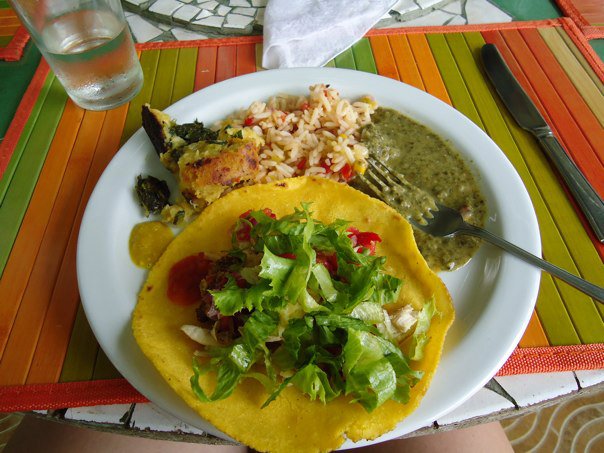
The act of us twelve whities waiting in line, blatantly not knowing what we were doing, was also quite an experience (this picture is neither roti nor doubles, I doubt any of us actually took a picture while we were in the restaurant, but it’s food from the next day, and was fantastic). As “local whites”, those Trinidadians or Tobagonians that are of Caucasian descent, are fairly rare on the islands, we really stood out. It was not uncommon for us to be pointed at, to have “hey, whities!” shouted at us, or to be talked about quietly (or not so quietly) as we went about the streets. Although this attention was not familiar to us, it wasn’t particularly hostile or offensive, and became a running joke between the students. I mean, we really did stand out no matter what we did, and Trinidad isn’t much of a tourist country with a deep history of colonialism. Who’s to blame people from observing an obvious pack of foreigners?
Well, I haven’t even touched on the other meals at Pax, the famous Shark Bake, or the propensity for the hot Tropics to serve hot soup, but that will come later. (Thanks again to Abby for the pics, I evidently took more pictures of birds than of food… and people…)
 what Was, what Is, and what Will Be
Leave a comment